Community updates delivered straight to your inbox
Access updates, events, and local alerts
Engage with neighbors, vote, and share concerns easily
Secure portal for dues, documents, and board news

Our Mission

Our mission to support & Strengthen your community

The York Mills Residents Association exists to serve the residents of York Mills — protecting what we love about our neighbourhood while advocating for the improvements our community deserves.

Our work is guided by three core commitments:

1. Community Safety & Connectivity
We believe every resident deserves to feel safe on their street, in their park, and throughout their neighbourhood. The YMRA actively engages with Toronto Police, City Transportation Services, and local councillors on issues including traffic calming, pedestrian safety, speeding enforcement, and crime prevention. We support Vision Zero road safety initiatives and advocate for safer crossings, reduced speed limits on residential streets, and better lighting in our community.

2. Neighbourhood Character & Property Value
York Mills is defined by its mature tree canopy, generous lot sizes, architectural heritage, and quiet residential streets. We work to ensure that new development — whether infill housing, mid-rise proposals, or commercial rezoning — respects the scale and character of our neighbourhood. We monitor Committee of Adjustment applications, respond to Official Plan amendments, and engage with the City’s planning process to protect what makes York Mills unique.

3. Resident Advocacy & Civic Engagement
We are your voice at City Hall. From opposing inappropriate development to pushing back against provincial planning overreach, the YMRA ensures that York Mills residents are heard. We keep our members informed, organized, and empowered to participate in the decisions that shape their community.

“A strong and vigilant ratepayers group is the best insurance in which you can invest to preserve your neighbourhood.”

Here are the official YMRA Objectives:

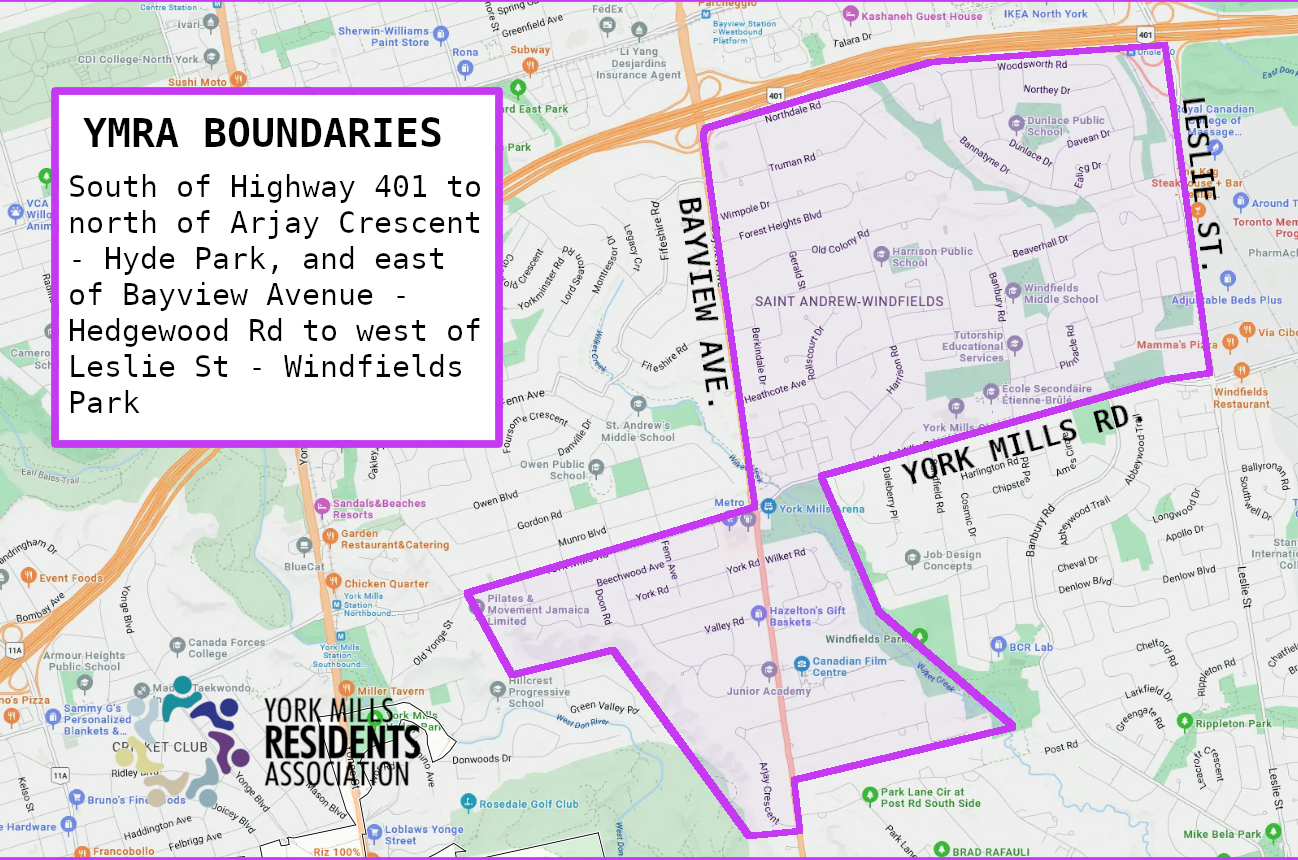
The objectives of the Association shall be to address matters related to the areas covered in the YMRA geographical boundaries, including:

  1. To safeguard and promote the interests of the residents within the geographic area bounded by York Mills Road, Bayview Avenue, Arjay Crescent, Bayview Ridge, Highland Crescent and Hedgewood Road, North York (“the York Mills Area”);

  2. To represent the position of the ratepayers of the York Mills Area before federal, provincial, municipal and other government authorities, and to participate in hearings and proceedings before relevant boards, tribunals, councils, courts and other bodies;

  3. To disseminate information for purposes of informing all residents within the York Mills Area of all matters which might affect their interests as residents;

  4. To co-ordinate the efforts of residents within the York Mills Area and to co-operate with and assist other similar ratepayer associations on matters of common interest to residents and taxpayers;

  5. To retain legal counsel and other consultants and advisors for purposes of attaining the above objects;

  6. To receive, acquire and hold gifts, donations, legacies, devises and membership fees;

  7. To do all such other things as are incidental or conducive to the attainment of the above objectives.

In 2022, the Ontario government passed Bill 23 — the More Homes Built Faster Act. It was sweeping legislation designed to speed up housing construction across the province. While the goal of addressing Ontario's housing shortage is legitimate, the law had significant side effects for established neighbourhoods like ours:

  • It overrode local zoning rules, allowing up to 3 residential units on almost any residential lot — without requiring any community consultation or City approval.
  • It reduced municipalities' ability to say no — limiting the tools Toronto had to protect neighbourhood character, rental housing, and green space.
  • It weakened the role of Conservation Authorities and limited third-party appeals, making it harder for residents to challenge developments.
  • It cut development charges — fees developers pay to fund schools, parks, and infrastructure — meaning growth comes with less funding to support it.

In short: the Province told developers "yes" before the City or residents could weigh in.

📎 Read more: Bill 23 — Legislative Assembly of Ontario | Plain-language summary — Canadian Centre for Housing Rights

This will close in 20 seconds